Meet Your Therapist
Katie Bonanno
Licensed Marriage & Family Therapist
Hello, I’m Katie. I’m a Licensed Marriage and Family Therapist and owner of Simple Love Counseling.
Psychology and counseling have always been interests of mine. I've always known that I wanted to help people and when I discovered a love of learning how the human mind works, this field seemed like a no-brainer (pun intended)!
I believe that we are all deserving of love and kindness no matter your background, race, gender, sexuality, etc. A main philosophy I work off of, is that we never do things just for the hell of it. There’s always a need (emotional or physical) that we’re trying to get met but sometimes the way we go about it isn’t working. When we put things into this view, we take away the labels of “good, bad, selfish, unworthy, etc” that we often put on behaviors and people. In shifting this viewpoint, we can often see people in our life in a different light. The distant husband or nagging wife now is able to be seen as the husband who is desperately trying to protect himself from hurt and the wife who is only trying to connect and love her husband. We’re then able to connect through empathy and understanding.
Hands down, my favorite part of my job is watching a couple reconnect through raw vulnerability or watching an individual realize that they are indeed worthy of love.
Relationship & Couples Counseling
Modalities I use with clients …
-
Relational Life Therapy is a practical approach to couples therapy. Unlike more traditional talk therapy, RLT is direct and active. This approach allows me to listen and reflect while actively coaching you in the moment, calling out unhealthy patterns as they show up in session and offering concrete tools to shift them. RLT helps couples recognize when they've slipped into blame, defensiveness, or one-upping each other, and teaches a different way to stay connected even when things get hard. This tends to be a much more straight forward approach to therapy and is more focused on consistent and sustainable change.
-
Emotionally Focused Therapy is one of the most well-researched approaches to couples therapy. It's grounded in attachment theory which is the idea that we're wired to need close, secure emotional bonds with the people we love, and that most relationship conflict is really a cry for connection in disguise. The fight about dishes or who texted back late is rarely really about that and instead about feeling unseen, unwanted, or unsafe in the relationship. EFT slows things down so partners can access and share the softer, more vulnerable feelings underneath the anger or distance and actually be met by your partner thus furthering the connection between them.
-
Cognitive Behavioral Therapy is one of the most widely studied and used forms of therapy, built on a simple but powerful idea: our thoughts, feelings, and behaviors are all connected. By changing unhelpful thinking patterns, we can change how we feel and act. The way we interpret a situation drives our emotional response. Two people can face the same event and react completely differently based on what they're telling themselves about it. CBT is active and skills-based. You'll leave sessions with concrete tools and strategies to try in real life.
-
Narrative Therapy is an approach that rests on a simple but powerful reframe: you are not your problem. It views people as the experts on their own lives and sees problems as separate from a person's identity, shaped by the stories they've been told (or told themselves) over time. The narratives we carry about who we are, what our relationship is like, or what we're "doomed" to repeat can quietly limit what feels possible and how we show up in life. By identifying the story that's been running the show, you can start intentionally writing a new one that reflects your values and the relationship you actually want.
Recreation & Play Meets Therapy
Playing lacrosse, kickball, literally basketweaving, and sea kayaking all for class credits informed my philosophies in therapy. In college I minored in recreational leadership which was counseling through activities. It was the idea that people behave as their truest selves when they are involved in play thus making it easier to see their habits, behaviors, and views of the world around them. This also provides an “in” for the counselor to point out behaviors and interactions in real time.
Through personal experiences in these classes, I learned that we grow when we’re outside of our comfort zone. Being outside of your comfort zone could be anything such as being vulnerable with your partner, learning a new activity, or being in a new place. This gives a unique opportunity to learn more about yourself, to grow, and challenge yourself. You never really know what you’re capable of until you try.
Studies also show that when couples engage in new or novel activities, it mimics the beginnings stages and intensity of a new relationship. In other words, getting out of a rut! I think far too often in adult life, we accept the status quo. We become comfortable and safe. But this also leads into falling into a rut and falling into a predictable routine.
Coming from my educational background and my passion for experiencing new things and playing, came the idea of a more “experiential couples therapy”. I started planning events and activities for couples to participate in together. These activities are meticulously planned to promote growth, connection, problem solving, and communication among partners while also having a chance to have fun and play together! When we’re involved in play, we let our guard down and become our truest selves. Who doesn’t want to connect with their partner’s truest self? I also use this framework in the therapy room. Sure, we can talk about your most vulnerable feelings but my goal with couples and individuals is for them to find their truest selves, drop the walls, and engage with others in life without fear.
Take chances, play together, be goofy, have fun, be silly! You only get one chance at living, might as well make it a good one.
Fun Facts About Me
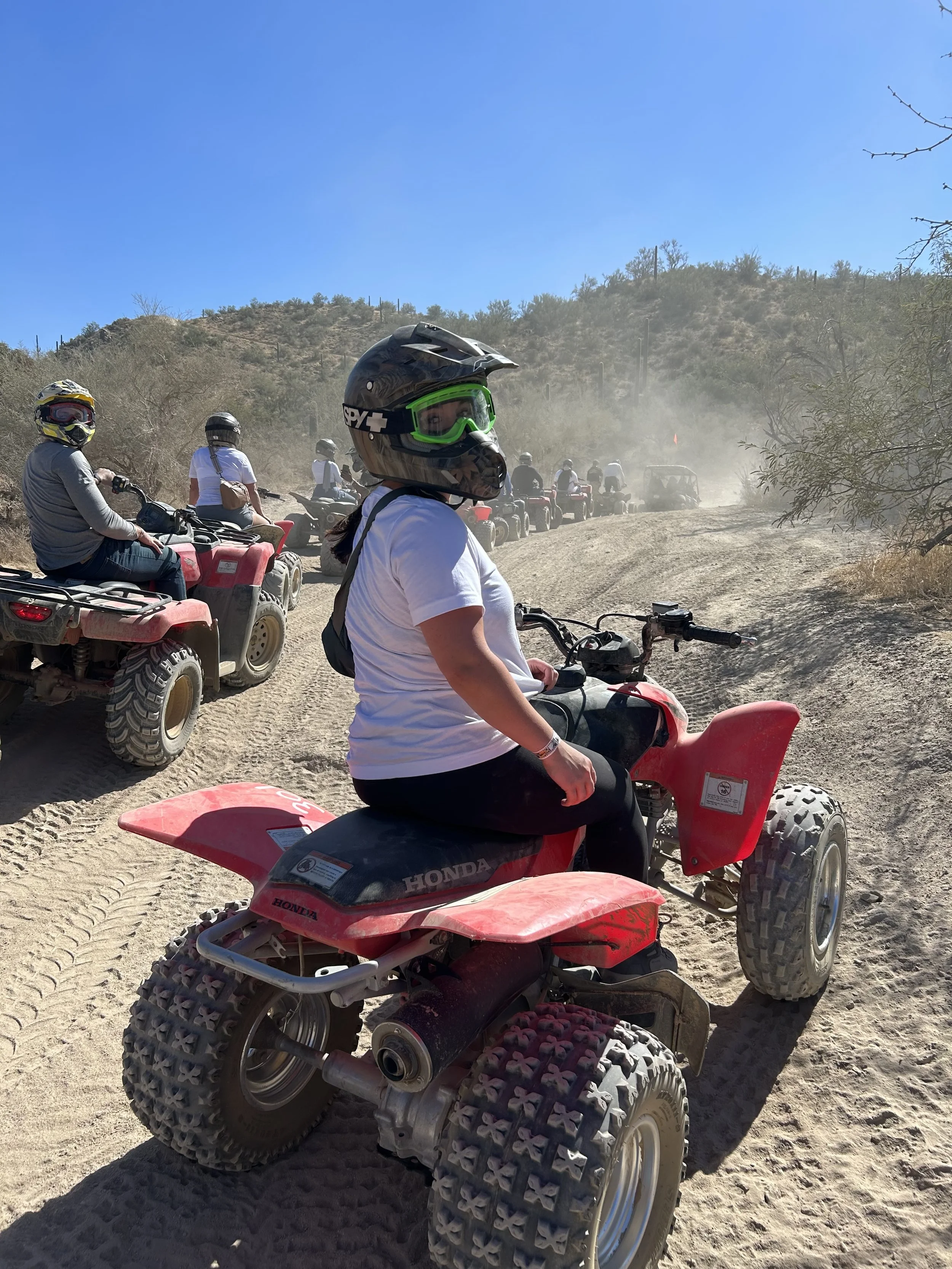
I started riding 4-wheelers when I was around 6 years old. Driving almost anything is my happy place. I’ve been lovingly dubbed a “speed demon”.
I broke my tailbone on a jet ski but didn’t realize it until a month later while doing squats! Ouch! However, a month after that with a still-broken tailbone I went 4-wheeling in the Arizona desert. No regrets!
I absolutely LOVE mysteries and puzzles. Books, games, escape rooms… as long as it’s a mystery or puzzle, I’m in!
Trying new foods is a favorite past time. I’m always especially curious about other culture’s foods. A strange food I’ve tried is Huitlacoche which is diseased corn and found in Mexican cuisine.
My husband and I have been ballroom dancing for 2.5 years! My favorite dances are West Coast Swing, Salsa, and Waltz.
I believe that traveling and exploring other cultures and customs is one of the best things we can do to build empathy and be better humans. When I travel I want to be immersed in another culture.
Therapy can help …
Improve your relationships
Therapy can help improve all relationships in your life by getting clear about what you want in relationships, your boundaries, and how you connect with people.
Build your confidence
Working through challenges and untangling feelings will help boost your confidence and trust in yourself. We work on giving you tools you can use in the future.
Get to know yourself
In counseling, we question everything. We play a curious detective to figure out who you are at your core and what makes you tick.